
GDPR Audit Logging
Middleware-based audit system automatically capturing login, logout, data access, modification, and deletion for every request.
Key Results
Client
Enterprise SaaS Client
Industry
Sustainability & ESG
Location
Europe
Overview
GDPR and similar regulations require audit trails of who accessed what data and when. Implementing logging in every view is error-prone and easy to forget. The platform handles sensitive user and company data, and demonstrating compliance required answering ‘who did what when’ for any request.
We built a middleware-based audit system that captures login, logout, data access, modification, and deletion—automatically, for every relevant request, with no view-level code required. Smart filtering ensures static files and admin internals don’t fill the audit log with noise.
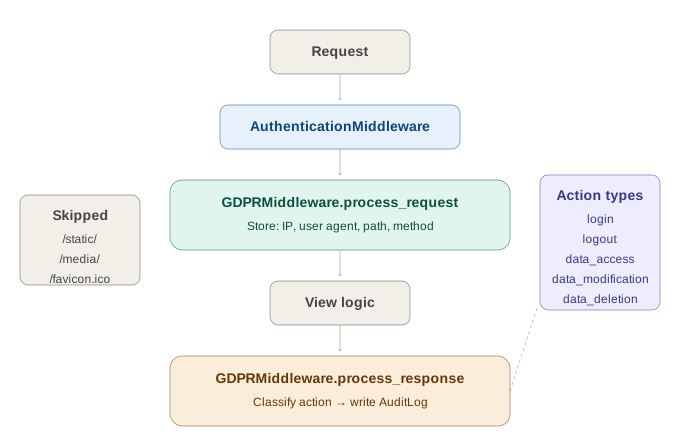
Architecture Overview
The Challenge
Comprehensive Coverage
Every data access, modification, and deletion needed logging—not just the ones developers remembered to instrument.
Right Level of Detail
Logs needed user identity, IP address, and action type—but not request bodies that might contain PII.
No Noise
Static files, media, and admin internals shouldn’t fill the audit log with irrelevant entries.
Our Solution
Architecture Overview
Middleware
Runs on every request automatically
Classifier
Derives action type from path + method
Audit Store
Metadata-only log entries
Automatic Classification
The middleware derives action type (login, logout, data_access, data_modification, data_deletion) from the request path and HTTP method. No view needs to declare what kind of action it performs.
Metadata Only Logging
Each log entry captures user ID, email, username, IP address, user agent, path, and method—never request or response bodies. This keeps the audit log useful without creating a PII storage problem.
Smart Filtering
Static files, media, favicon, and admin i18n paths are skipped in both phases. The audit table contains only user-driven actions.
Two-Phase Capture
process_request stores minimal data; process_response classifies and writes—ensuring the user is authenticated before logging. Fail-safe writing ensures a failing audit write never breaks the user’s response.

Performance Metrics
Transaction Throughput
Response Time Distribution
100%
Coverage
5
Action Types
Zero
View Changes
Zero
PII Stored
Technology Stack
Backend
- Django
- Python 3.11
- Django Middleware
Compliance
- GDPR
- Audit Trail
- PII-Free Logging
Data
- PostgreSQL
- Audit Table
- Thread-Safe Writes
Outcomes & Impact
Compliance Impact
- Every authenticated request automatically logged—no developer action required
- Five action types enable compliance reporting: login, logout, access, modification, deletion
- Audit log contains zero request body content—no accidental PII storage
Technical Achievements
- New views are automatically covered without any logging code
- Path-based rules detect login/logout by patterns; HTTP method determines action type
- Fail-safe writing ensures audit failures never break user responses
Operational Benefits
- Two-phase capture ensures user is authenticated before logging begins
- Smart filtering keeps audit table clean—only user-driven actions stored
- Helper function extracts user info consistently, decoupled from User model internals
“The audit logging system gave us instant GDPR compliance without touching a single view. Our compliance team can answer any regulator question about data access in minutes.”

Compliance Officer
Enterprise Client
Related Case Studies
Key Vault Secrets Management
Azure Key Vault as single source of truth for 40+ secrets with CI sync, managed identity auth, and file-based secret support.
Multi-Tenant Platform Architecture
One codebase serving biodiversity and governance platforms with URL-based routing, company isolation, and shared authentication.
Security Middleware Stack
Defense-in-depth request hardening with size limits, injection logging, brute-force tracking, and rate limiting—all without external services.
Ready to build something similar?
Let's discuss how we can apply the same engineering excellence to your project.